
Sex Offender Checks in Shenandoah County
The Virginia State Police services directory is the official starting point for the Virginia Sex Offender and Crimes Against Minors Registry. VSP administers the registry under Title 9.1, Chapter 9. The public search is free and supports both person-based and place-based research. For Shenandoah County, a reader can start with a known name or narrow the map by county, town, ZIP, or address. A public result should then be checked against its identifiers and dates rather than accepted from a name alone.
The registry is only one record layer. It shows registration and verification information, not the complete police narrative, every court filing, or current jail status. A conviction may have occurred outside Virginia even when the current registered address is in Shenandoah County. For the filed charge and disposition, use the relevant court record. For a local registration appointment, a suspected reporting problem, or a detail that needs direct confirmation, contact the Shenandoah County Sheriff's Office at 540-459-6100 and ask which unit handles registry matters. Research found no published local registration fee, appointment schedule, or document checklist, so those points must be confirmed before a visit.
Shenandoah County Registry Search Routes
The official channels answer different questions. The VSP registry is the direct Virginia source. The National Sex Offender Public Website, or NSOPW, searches participating public registries across state and territorial lines. That broader layer can help when an offense, former address, or registration duty crosses a border, but a matching NSOPW result still points back to the source jurisdiction for its details.
The NSOPW search screen below shows the neutral national interface. It does not display or center a private registrant.
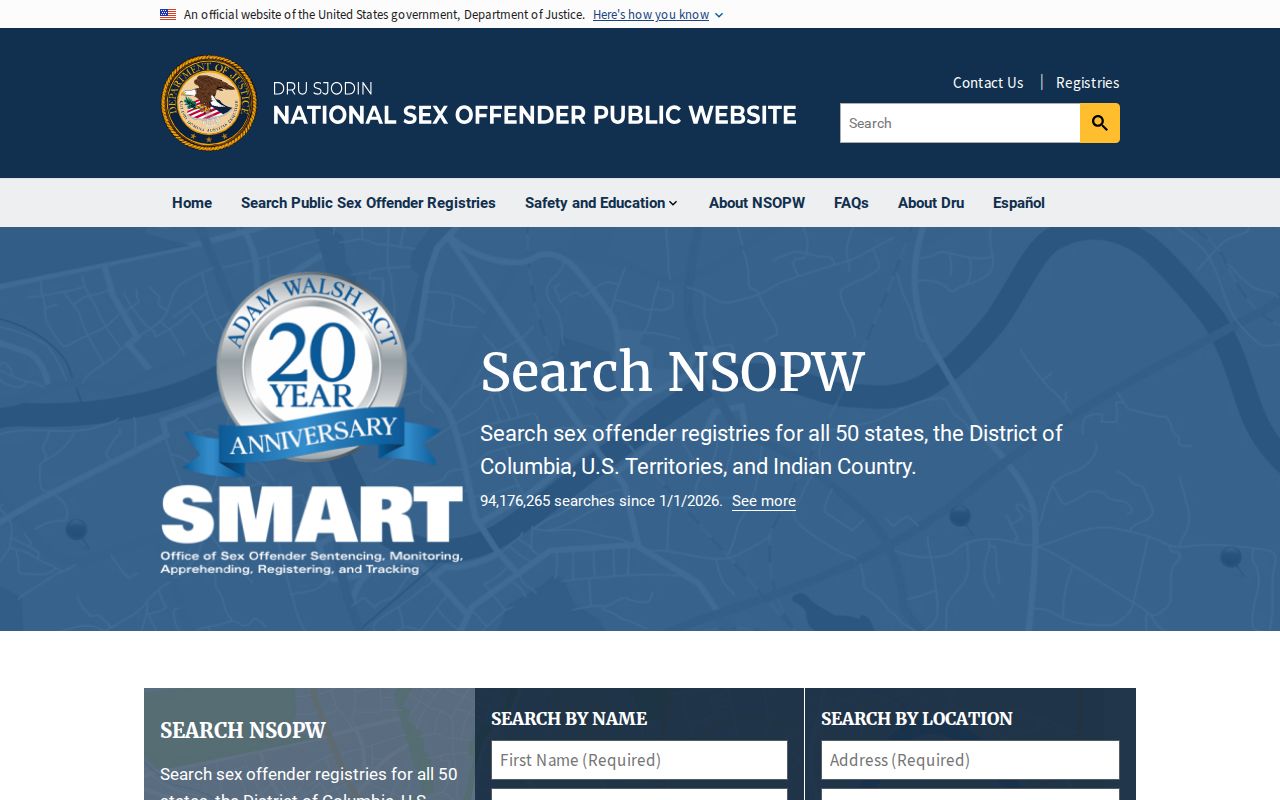
The broad search is useful for discovery, while VSP remains the primary source for a Virginia registration profile and its current state fields. Neither channel replaces a clerk-certified criminal case record.
VSP also offers a subject-authorized SP-167 product that can combine a Virginia history search with a registry search for $20. That mailed, notarized process is separate from the free public registry. It should not be confused with an anonymous online background check. For most community-awareness questions, start with the free registry and reserve SP-167 for a consent-based official Virginia history request.
How to Search the Virginia Sex Offender and Crimes Against Minors Registry
A careful Shenandoah County sex offender search begins with the least data needed to identify the right result. Dynamic controls may change, and the exact radius choices were not verified in the research. Use the live interface labels rather than assuming a distance option. Keep a note of the search place and date because address and verification data can change.
- Open the VSP registry through the official services page and read the conditions for public use.
- Choose a name search or a geography route. Enter Shenandoah as the county, or use a city, ZIP, street address, or radius control where the current interface offers it.
- Review the list or map without treating proximity as proof of conduct. Compare available name, physical description, photo, and location information.
- Open the relevant profile and read the conviction jurisdiction, offense, tier, status, address, and registration or verification dates together.
The registry exposes several search controls, but no single field is a complete identity check. A county filter is useful for a broad local scan. A name can find a known person. Address and radius tools answer a place-based question, though a plotted point should be read within VSP's own location and data caveats.
| Field label | Control | Use | Verified note |
|---|---|---|---|
| Last name | Text | Person search | Primary surname field |
| First name | Text | Narrow a name | Use with other identifiers |
| County | Select | Local geography | Choose Shenandoah County |
| City or ZIP | Text or select | Town or postal area | Useful when county scope is too broad |
| Address and radius | Geography or map | Nearby-area view | Exact live radius options need reinspection |
| Search and Reset | Buttons | Run or clear query | Map and list controls may also appear |
Shenandoah County Address Search Limits
A map point is a lead, not a measurement of personal risk. The Virginia system classifies registrants by the conviction-based tier rules in state law. It does not publish a reader-created risk score. Distance from a home, school, road, or other place also does not show when a person is present, what supervision conditions apply, or whether an address has changed since the last public update.
Use neutral inputs when checking an address or Shenandoah County ZIP. Review the profile's status and verification date, then follow VSP's data notes. If a point appears misplaced or an address seems stale, contact VSP's Registry Unit rather than drawing a conclusion from the map. The research did not establish a county-specific public map, a local email alert system, or local residency-distance rules. Those gaps should not be filled with rules borrowed from another Virginia locality.
Note: A registry location can differ from the place of conviction, and neither field by itself establishes current custody or an active case.
Inside a Registry Profile
A public Virginia profile groups identity, location, conviction, and registration facts. Read those groups together. The photo and physical description help separate people with similar names. The conviction jurisdiction can explain why the cited offense or statute came from another state. Registration dates describe registry activity, while a conviction date belongs to the underlying case. Vehicle, school, or work information appears only where publication is authorized.
| Name and aliases | Legal name plus published former or alternate names used to distinguish identities. |
|---|---|
| Photo and description | Photo and permitted details such as sex, race, height, weight, hair, eyes, marks, and tattoos. |
| Birth information | Only the birth details Virginia permits for public display. |
| Registered address | The location reported for registry purposes, subject to status and update caveats. |
| Offense information | Conviction offense, jurisdiction, statute, and date shown by the profile. |
| Tier and status | The statutory offense tier and current published registration or compliance status. |
| Registry dates | Registration and verification dates that help a reader judge how recent the entry is. |
| Other authorized fields | Published vehicle, school, or work information when Virginia law authorizes it. |
A profile is not a full Shenandoah County criminal record. It may not show the pleadings, amended charge, sentencing order, or later docket events that explain the conviction. The broader Shenandoah County criminal history overview routes those questions to the court, state repository, jail, or originating agency.
Shenandoah County Profile Context
Three dates can tell different parts of the story: the offense date, the conviction date, and the most recent registration or verification date. The current Shenandoah County address may be far from the court that entered judgment. A status label speaks to the registry entry; it does not prove that the person is incarcerated, under active prosecution, or free from all supervision. Those questions belong to VADOC, a jail, or the court that holds the case.
Likewise, a profile photograph should be used only to confirm a possible match. The research protocol requires interface images that do not single out a registrant. That approach preserves the public search function without republishing an individual's profile or creating a local gallery. When identity remains uncertain, use the official source's contact route. VSP's Registry Unit can be reached at 804-674-2825 or sor@vsp.virginia.gov.
Virginia Registration Levels and Requirements
Virginia tiers come from offense categories in Title 9.1, Chapter 9. They are not a psychological forecast made by the public or by the search interface. Section 9.1-908 governs duration, and §9.1-910 provides a limited court-petition route for some eligible people. The table uses only the duration conclusions supported by the research; it does not invent a local verification schedule that Shenandoah County has not published.
The capture below shows Virginia's Registry Act itself. Reading the law next to a profile helps separate tier labels from assumptions about risk.
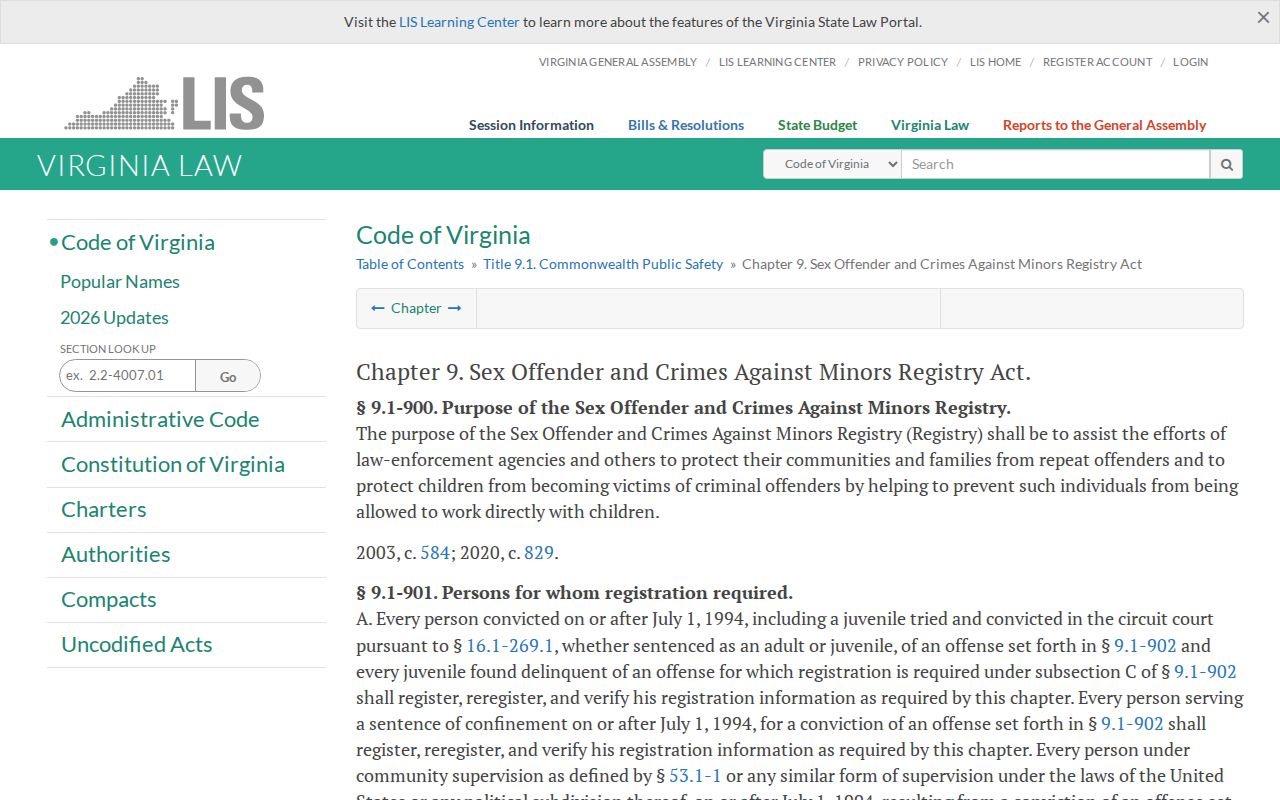
The statute controls inclusion, publication, verification, duration, removal, and use, while local law enforcement handles the practical registration contact.
| Category | Virginia meaning | Duration or relief note |
|---|---|---|
| Tier I | Offense-based Tier I classification | A person with one eligible offense may petition no earlier than 15 years after the later statutory event; relief is not automatic. |
| Tier II | Statutory Tier II classification | Do not assume a fixed public expiration; the governing law controls. |
| Tier III | Most stringent statutory tier | The ordinary §9.1-910 removal route is excluded. |
| Specified murder or former offense | Separately covered statutory category | Lifetime registration duty under §9.1-908. |
A Tier I threshold allows a petition, not deletion by the passage of time. The court obtains the complete criminal history and registration or verification information, then makes the findings required by law. Tier III, multiple registration convictions, specified former offenses, and murder are excluded from the ordinary removal route described in §9.1-910.
Shenandoah County SP-285 Notices
Manual searches are not the only documented access channel. VSP Form SP-285 lets a requester seek notice of registration or reregistration in the same or a contiguous ZIP code. This is a state notification process, not a county-run alert app. The live form should be checked before submission because its address and contact fields can change. The research identifies requester contact, ZIP, signature, and submission details as fields that need current inspection.
SP-285 is useful when a Shenandoah County resident wants ongoing ZIP-based notice without repeating the same map query. It does not guarantee notice about every change outside the form's geographic rule, and it does not expand what a public profile lawfully shows. Keep the completed request information and confirm the current submission instructions with VSP. For questions, the Registry Unit phone and email are the direct state contacts.
Community Notification and Lawful Use
Virginia publishes registry information for awareness and safety planning. Lawful use means reading the state record in context, discussing reasonable household safety steps, and reporting a suspected compliance issue to trained officials. It does not authorize threats, public confrontation, harassment, or vigilante action. A Shenandoah County search result should be handled with care because wrong-person matches and stale interpretations can harm people and can obstruct a lawful investigation.
Registry misuse is a crime: Virginia's Registry Act governs use of published information. Do not use it to harass, intimidate, or threaten a registrant or household.
Community notification is broader than a single search. VSP supplies the public registry and the SP-285 ZIP notice route. The Sheriff is the first local contact for registration logistics and concerns in Shenandoah County, while VSP's Registry Unit can address state-system questions. If there is an urgent threat, use the appropriate emergency channel rather than trying to investigate a profile independently.
Note: Registry information supports community awareness, but it is not proof of new misconduct and does not replace a current court or custody record.
Reporting Registry Noncompliance in Shenandoah County
When a Shenandoah County registry entry appears inaccurate or a person may not be following a registration duty, do not approach the person. Record the public profile URL or other neutral identifying detail, note what appears inconsistent, and contact law enforcement. The Shenandoah County Sheriff's Office is at 810 North Main Street, Suite 1, Woodstock, Virginia 22664, and its main number is 540-459-6100. The county's law-enforcement directory lists the other local agency lines. Ask for the unit that handles sex offender registration before traveling because no official appointment hours or required-document list was found.
State-level questions go to the VSP Registry Unit at 804-674-2825 or sor@vsp.virginia.gov. The Sheriff's court and magistrate information also helps distinguish judicial process from the registry unit's role. Explain the concern without adding claims that the public record does not support. Officials can compare the report with nonpublic verification data and decide whether follow-up is needed. That channel protects the community and avoids turning a public search into confrontation.